Acupressure
points can be used to enhance many aspects of life. In
addition to managing stress, you can use acupressure to relieve
and prevent sports injuries. Sports massage has been widely used
by athletes before and after Olympic events. Acupressure complements
sports medicine treatments by using points and massage techniques
to improve muscle tone and circulation and relieve neuromuscular
problems.
The Chinese have
also used acupressure as a beauty treatment for thousands of years.
You can use potent points to improve skin condition and tone and
relax the facial muscles, which can lessen the appearance of wrinkles
without drugs.
Although acupressure
is not a substitute for medical care, it is often an appropriate
complementary treatment. It can, for instance, speed the healing
of a broken bone once it has been set, or aid a cancer patient
by helping to alleviate some of the associated pain and anxiety
of the disease.
Similarly, acupressure
can be an effective adjunct to chiropractic treatment. By relaxing
and toning the back muscles, acupressure makes the spinal adjustments
easier and more effective, and the results last longer. In fact,
the two therapies were originally practiced together in ancient
China.
Psychotherapy
patients can derive benefits from acupressure by using it to heighten
body awareness and deal with stress. When powerful emotions are
free and unresolved, the body stores the resulting tension in
the muscles. Acupressure can help restore emotional balance by
releasing the accumulated tension caused by repressed feelings.
An acupressure
point actually has two identities and ways of working. When you
stimulate a point in the same area where you feel pain or tension,
it's called a local point. That same point can also relieve
pain in a part of the body that is distant from the point, in
which case it is called a trigger point. This triggering
mechanism works through a human electrical channel called a meridian.
The meridians are pathways that connect the acupressure
points to each other as well as to the internal organs. Just as
blood vessels carry the blood that nourishes the body physically,
the meridians are distinct channels that circulate electrical
energy throughout the body. They are thought to be part of a master
communications system of universal life energy, connecting the
organs with all sensory, physiological, and emotional aspects
of the body. This physical network of energy also contains key
points that we can use to deepen our spiritual awareness as we
heal ourselves.
Because the stimulation
of one point can send a healing message to other parts of the
body, each acupressure point can benefit a variety of complaints
and symptoms. Therefore, in the following chapters you will find
a particular acupressure point used for a variety of problems.
The highly effective acupressure point in the webbing between
your thumb and index finger, for instance, is not
only beneficial for relieving arthritic pain in the hand, but
also benefits the colon and relieves problems in the facial area
and the head, including headaches, toothaches, and sinus problems.
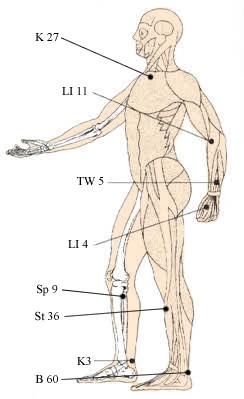
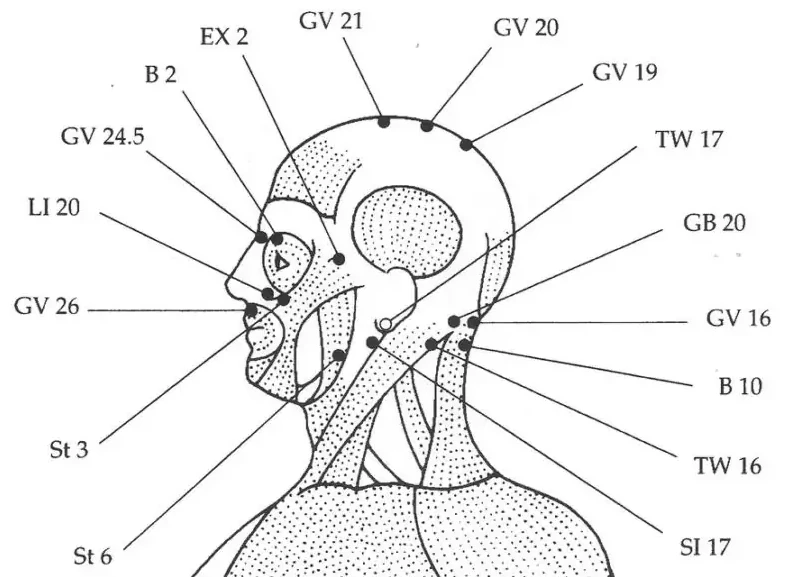
You
locate an acupressure point by referring to anatomical landmarks.
To help you find them, all of the points in this book are illustrated
with a description of these landmarks (such as bone indentations
and protrusions).
Some acupressure
points lie underneath major muscle groups. While points near a
bone structure usually lie in an indentation, muscular points
lie within a muscular cord, band, or knot of tension. To stimulate
the point, press directly on the cord or into the hollow.
As acupressure
evolved, each of the 365 points was named poetically, originally
with a Chinese character. The imagery of its name offers insight
into either a point's benefits or location. For instance, the
name Hidden Clarity refers to the mental benefit of the point:
It clears the mind. Shoulder's Corner refers to that point's location.
The Three Mile Point earned its name because it gives a person
an extra three miles of energy. Runners and hikers have used this
famous point to increase stamina and endurance.
Some of the names
of the acupressure points also serve as a powerful meditation
tool. By pressing a point and silently repeating its name while
you visualize its benefit and breathe deeply, you can realize
the full potential power that each point offers. As you hold the
Sea of Vitality points in your lower back, breathe deeply and
visualize each breath replenishing your deep reservoir of vitality.
Use the power of your mind to strengthen and help heal your lower
back.
You can create
affirmations with the names of the points -- powerful action statements
that amplify a point's benefits. For example, hold the Letting
Go points on the upper, outer chest with your fingertips. Breathe
deeply. Imagine yourself letting go of tension, frustration, and
stress. As you hold and breathe into these points, repeat to yourself
that you are now letting go of all negativity and irritability.
In addition to
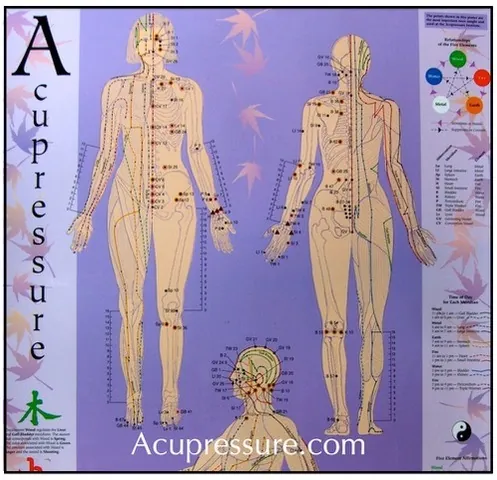
its name, each point was assigned an identification number to
track its placement along the body. Point location numbers, such
as St 3 or GB 21, are a standard referencing system used by professional
acupressurists and acupuncturists and so I use them as an additional
label, too. These notations are explained in the Glossary, but
you do not need to know or remember any of these numbers to practice
the self-acupressure techniques in this book.
© Copyright 1990 Michael Reed Gach & Bantam Books,
All Rights Reserved
Tonic points improve your condition and maintain general health. They strengthen
the overall body system and fortify various internal organs and
vital systems of the body.
Caution: This point is forbidden during pregnancy,
because its stimulation can cause premature contractions in the
uterus.
|